


SEO PowerSuite
SEO category is sponsored by SEO PowerSuite. All the SEO tools you'll ever need under one roof. Track rankings, analyze competitors, build links and do on-page SEO with ease. Get your free copy now!
Data is the currency of online marketers. If you’re an SEO or digital marketer, you know exactly what I mean. You live in a sea of data — numbers, line graphs, bar graphs, pie graphs, venn diagrams, percentages, proportions, analyses, analytics, and every combination of said metrics.
I get that. I’ve helped to found two analytics companies. Sometimes, though, it’s necessary to get the quick-and-dirty on things — the barebones numbers that provide the core information source on a website.
Those are the numbers that I want to explain in this article. When you’re finished reading this article, you’ll know the eight data points that will give you an accurate read on your website. Then, you can take action based on what you know.
What you’re about to discover will enhance your ability as an SEO, a marketer, and a digital expert.
Domain Authority
The Domain Authority of a website is a number developed by Moz that functions as a comparative metric for how important and powerful your website is.
Domain Authority is Moz’s calculated metric for how well a given domain is likely to rank in Google’s search results. It is based off data from the Mozscape web index and includes link counts, MozRank, and MozTrust scores, and dozens of other factors. It uses a machine learning model to predictively find an algorithm that best correlates with rankings across thousands of search results that we predict against.
Domain Authority is measured on a 100-point scale. If your site is in the 20s, it’s not so hot. If your site is in the 90s, you’re doing really well.
Why It Matters
The Domain Authority metric has proved to be one of the most reliable numbers for determining the success of a website in the SERPs. A higher DA invariably translates into bigger traffic and better search ranking.
I’ve developed a chart to help you understand your DA. Find out your domain authority (“Where to Find It” below), and then find out how you’re doing.
Thankfully, you can improve your Domain Authority through careful and persistent work.
Where to Find It
Domain Authority is publicly available for any website. You can use the following free sources
- http://www.opensiteexplorer.org/ (limit: three daily without paid subscription)
- http://www.bulkdachecker.com/ – (provides the DAs for as many as 200 URLs at a time)
Site Speed (Load Time)
A website’s speed is basically how fast it appears in a user’s browser.
Technically, site speed is dependent upon load time. Load time calculates the latency from the point at which a user submits a request. The network server time and browser time are both factored into the equation, along with the page size (measured in bytes), and requests.
Though there are a variety of technical factors to load time, the most important issue to take notice of is the number of seconds/milliseconds it takes for your page to appear.
Why It Matters
Site speed is crucial for two related reasons — 1) SEO and 2) user experience. From an SEO standpoint, it’s apparent that Google devalues sites with long load times. This may be tied to the user experience issue. Pages that take a long time to load have higher bounce rates and lower levels of engagement.
You know this experientially. If a page takes a long time to load, you probably become impatient. You may click off to a new tab to pass the time while the slow-loading page comes into view. Or, you may just forget about it altogether.
Where to Find It
There are a variety of helpful places you can get site speed metrics. Here are the top three free places:
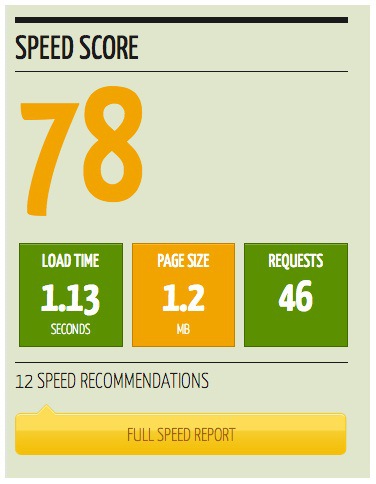
Quicksprout – (full disclosure, this my company) My analysis tool gives you both a basic speed score, and a full report. The “speed score” is a handy number for determining how you rank, along with load time (in seconds), page size, and requests.
0 Komentar
Penulisan markup di komentar